Over a third of Dutch workers use AI for their jobs. That sounds like a lot, especially for something that's only been around for a few years, until you realize what that group achieves with it and how easily the rest could join them.
This month, one of the most comprehensive studies on AI use in the workplace was published. Researchers from Harvard, the Federal Reserve, and Goethe University Frankfurt surveyed more than 55,000 workers across seven countries, including the Netherlands.
What does AI deliver for Dutch workers?
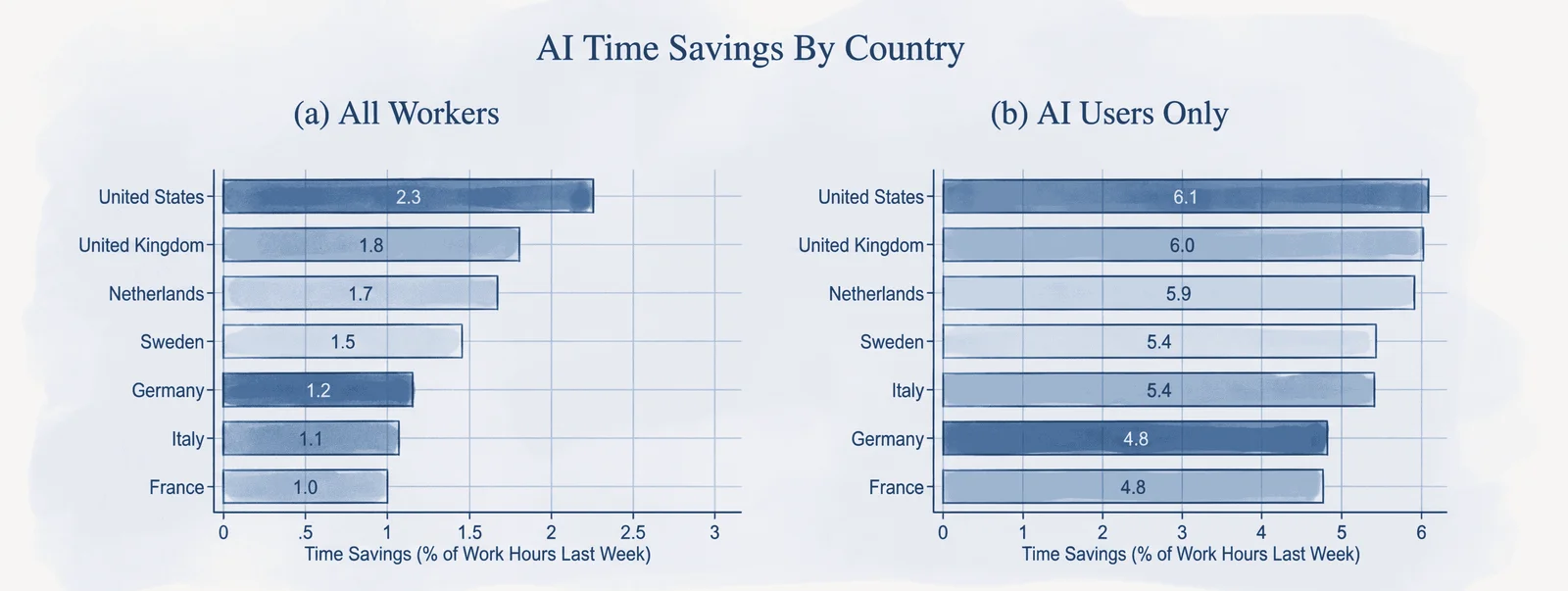
Dutch AI users spend an average of 7.2% of their work week on AI tools. They report that AI saves them 5.9% of their working time. In a 40-hour work week, that means you use AI for about 3 hours and save just over 2 hours on top of your time investment.
This aligns with what experimental research finds. The researchers compared self-reported savings with results from controlled experiments — from software developers completing tasks 26% faster, to consultants completing 12% more tasks at higher quality, to customer service agents resolving 15% more issues per hour. The survey results fit that picture.
What do people use it for?
The most common application is writing: 55% of AI users deploy it for communication. Next come information search (51%), translation and summarization (46%), and generating new ideas (40%). On average, an AI user applies it to four different types of tasks.
So it's not a niche tool for developers. The broad range of applications also explains why adoption cuts across sectors and professions, though there are significant differences. In IT and communications, nearly half of workers use AI. In hospitality, it's less than a quarter.
Why don't two-thirds use it?
This is where it gets really interesting — and where the most gains can be made. The tools are available to everyone. ChatGPT, Claude, and Gemini are free to use, so access isn't the problem.
The researchers asked non-users about their main reason. The two most common answers in the Netherlands: "AI isn't useful for my work" and "I haven't heard of it." The latter is striking, in 2026, a substantial share of workers still say they don't know what generative AI is.
But the data reveals something more important than individual reasons. The strongest predictor of whether someone uses AI isn't education, isn't age, isn't sector. It's whether their employer encourages them to do so.
The power of a simple signal
The researchers looked at three things employers can do: encourage, provide tools, and offer training.
Among workers whose employer encourages AI use but provides no tools or training, 47% actually use AI. Among workers who receive no encouragement: 10%. A fivefold difference, driven purely by the employer.
Tools help too (21% adoption without encouragement but with tools), but the effect is smaller. And the effect of training also pales compared to employer encouragement. Of course, training can itself be a form of employer encouragement and be effective in that way. But the easiest win clearly lies in the signal the employer sends to the team.
The researchers also found that companies with stronger management practices — rewarding performance, basing promotions on results, addressing underperformance — encourage their people to use AI more often. It's no coincidence that AI adoption is higher at well-managed companies. Those companies are accustomed to actively embracing new ways of working.
Where the Netherlands stands
At 36% adoption, the Netherlands is in Europe's leading group, alongside Sweden and the UK. For comparison: the US is at 43%, Italy at 26%. But usage intensity shows there's room for growth. American AI users spend nearly 13% of their work week on AI; Dutch users 7%. And that's mainly because organizational buy-in differs.
A notable detail: the gap with the US doesn't exist at small companies. Dutch workers at companies with fewer than ten employees use AI just as often as their American counterparts. The difference emerges at larger organizations — precisely where encouragement, tool policies (such as bans), and management culture matter most.
And there's good news from the research: no link was found between AI adoption and job loss. Not in the Netherlands and not elsewhere. The fear that AI costs jobs finds no support in this data so far.
What this means for your organization
The conclusion is fairly straightforward. The barrier to AI adoption is in most cases not technical and not financial. It's psychological and organizational.
If you want more people on your team to start using AI, the most effective intervention is to express this structurally — to encourage and embrace it. It's saying you expect it. Bringing it up in your weekly standup. Showing the way by doing it yourself. Seeking more structural (external) help if needed. Providing tools helps, but without the accompanying signal from the employer, adoption stays low.
The question isn't "which AI tool should we buy?" but "when was the last time I told my team they're allowed (and expected) to use AI?"
Based on "Mind the Gap: AI Adoption in Europe and the U.S." (NBER Working Paper 34995, March 2026) by Alexander Bick, Adam Blandin, David J. Deming, Nicola Fuchs-Schündeln, and Jonas Jessen.